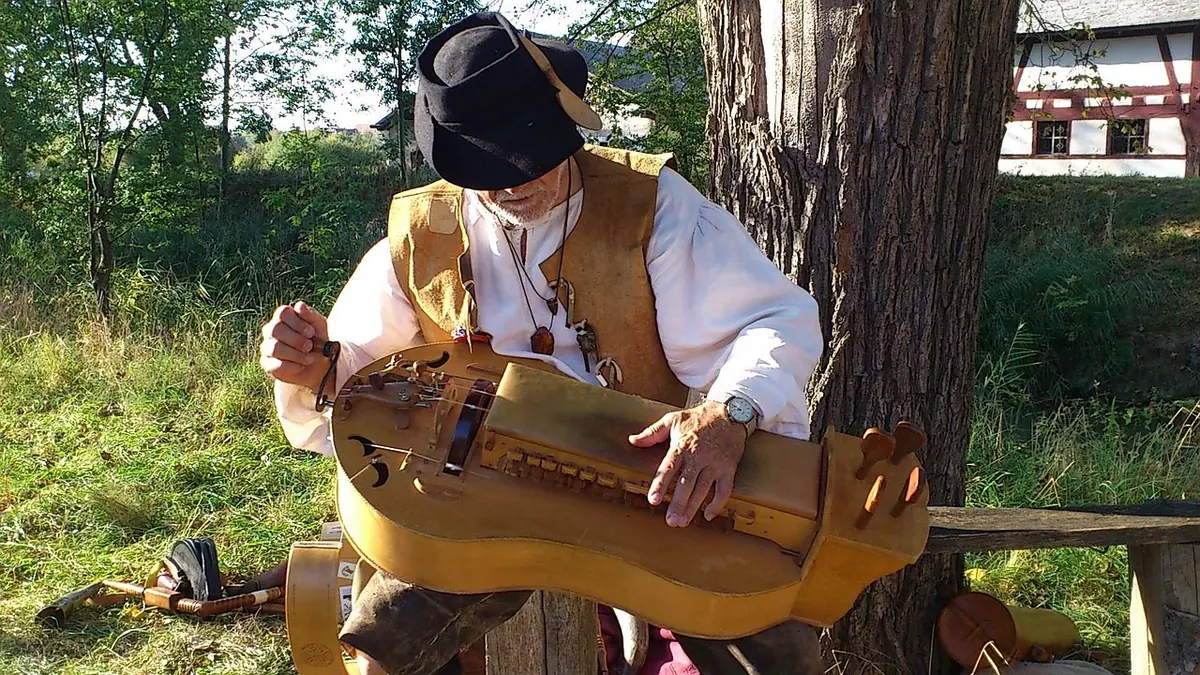
Play a song by Bernart de Ventadorn beside one by Adam de la Halle and the family resemblance is immediate: a single voice, a single melodic line, a strophic poem, a bowed or plucked instrument filling in underneath. The differences are just as real, and they go deeper than vocabulary. Troubadours and trouvères were neighbours, rivals and eventually ancestors of one another, but they composed in different languages, for different paymasters, and their songs reached us through very different accidents of survival.
Getting the distinction straight is not pedantry. It tells you where to look for a song, which editions to trust, and what a recording is likely to be doing with the rhythm. It also keeps us from flattening a rich medieval landscape into a single idea of the “medieval singer.” The troubadour and the trouvère belonged to overlapping but distinct worlds, and the overlap is part of the story.
The labels are not arbitrary. In Occitan, the medieval language of southern France, the word for “yes” was oc; in Old French, the language of the north, it was oïl. Dante, writing in Latin in the early fourteenth century, grouped the Romance languages by precisely this marker, distinguishing the lingua d’oc, the lingua d’oïl and the lingua de sì. The troubadours composed in Occitan; the trouvères composed in Old French. That is the first and most reliable difference.
The names themselves come from related verbs. Troubadour derives from Occitan trobar, and trouvère from Old French trover, both meaning “to find” or “to compose.” A troubadour was a “finder” of songs in Occitan; a trouvère was a “finder” in French. The similarity is not accidental. The northern poets inherited forms, attitudes and perhaps melodies from the south, and they adapted them to their own language and courts.
So the difference is linguistic first and stylistic second. A troubadour song is not automatically more courtly, more rustic, more learned or more emotional than a trouvère song. The labels tell you which language and tradition a poet worked in, not how good or how sophisticated the result is.
The troubadours flourished in Occitania, a broad cultural zone that included Aquitaine, Toulouse, Provence and neighbouring regions. The first troubadour whose songs survive is William IX, Duke of Aquitaine, writing around the turn of the twelfth century. Later names such as Bernart de Ventadorn, Jaufre Rudel, Marcabru, the Comtessa de Dia and Guiraut Riquier show the range of the tradition: aristocratic poets, professional poets, moral satirists and love poets, writing across two centuries and across a wide southern landscape.
The trouvères appear later, from the later twelfth century onward, in the north: Champagne, Artois, Flanders, Picardy and the Île-de-France. Their names include Blondel de Nesle, Gace Brulé, Thibaut de Champagne and Adam de la Halle. Some were great lords; some were clerics or professional musicians; some worked in towns. Adam de la Halle, active in Arras in the later thirteenth century, is a particularly useful example because he wrote not only monophonic songs but also motets, rondeaux and dramatic works such as the Jeu de Robin et Marion.
Chronology matters here. The troubadour tradition began earlier and declined earlier, partly because the Albigensian Crusade of 1209 to 1229 devastated the southern courts that had supported it. Troubadours dispersed to Italy and Spain, and Occitan song continued, but the centre of gravity shifted. The trouvère tradition, by contrast, continued to thrive in northern France into the late thirteenth century, where it became entangled with the polyphony of the Notre Dame school and the urban culture of Arras.
Both traditions were courtly, but their patronage systems were not identical. A troubadour might be a nobleman composing for his own circle, or a professional poet attached to a court and dependent on gifts and favour. The joglar, or performer, was not necessarily the composer; a song could be written by one person and sung by another. The troubadour’s reputation often rested on his craft as a trobador, a maker of poems and melodies, even if he did not perform them himself.
Trouvères operated in a similarly varied world, but northern France offered different institutional possibilities. The town of Arras, for example, had a confraternity of jongleurs and bourgeois patrons who supported elaborate musical and dramatic productions. Royal and aristocratic courts, especially that of Thibaut de Champagne, provided another kind of patronage. This does not mean that trouvères were more “urban” than troubadours, but it does mean that the northern repertoire often reflects a denser mix of court, town and church.
Paymasters shape tone. A poet writing for a southern lord might produce a sirventes, a political or moral satire aimed at a named enemy; a poet writing for a northern court might produce a refined chanson of courtly love or a jeu-parti, a debate song staged between two speakers. The genres overlap, but the social settings give them different accents.
The two traditions share a great deal. Both composed strophic, monophonic songs: one melodic line, usually without written accompaniment, with a poem divided into stanzas. Both cultivated the canso or chanson, the courtly love song; the sirventes, the political or moral song; the tenso or jeu-parti, the debate song; the pastorela or pastourelle, the encounter between a knight and a shepherdess; and the alba or aube, the lovers’ parting at dawn. A listener moving from Bernart de Ventadorn’s Can vei la lauzeta mover to Adam de la Halle’s songs will hear the same basic texture, but also a different language, a different melodic idiom and a different manuscript world.
The trouvère repertoire is broader in some directions. It includes more surviving polyphony, more motets, more rondeaux and more dramatic music. Adam de la Halle is a case in point: he moves between monophonic song, polyphonic motet and theatrical entertainment. The troubadour repertoire is more concentrated in the monophonic lyric, though it has its own experiments, such as Raimbaut de Vaqueiras’s multilingual descort, which deliberately mixes languages and forms to express discord.
Influence ran mostly from south to north, but not in a simple line. Occitan lyric spread to Catalonia, Castile, Italy and beyond; trouvères adapted its forms into French; and German Minnesang drew on both traditions. The troubadour and trouvère are therefore not two isolated species but two branches of a connected medieval lyric culture.
What we know about these poets depends on what happened to their songs after they were composed. Troubadour songs survive largely in chansonniers compiled in Italy and northern France, often centuries after the poets lived. Some of these manuscripts include vidas and razos: short prose biographies and explanations that tell us who the poet was supposed to be and what a song was supposed to mean. These are invaluable, but they are also later constructions, not neutral facts.
Trouvère songs survive in northern French chansonniers that often preserve musical notation more consistently. That does not mean trouvère music is better understood; it means the evidence is differently shaped. A troubadour song may survive in a manuscript without music, or with a melody added by a later scribe; a trouvère song may survive with notation but without a clear rhythm. Editions and recordings are therefore acts of interpretation, not simple transcriptions.
This is why the distinction matters to performers and listeners. If you are looking for a troubadour song, you may need to consult a critical edition that weighs Italian manuscript readings against Occitan sources. If you are looking for a trouvère song, you may need to decide how to read square notation and whether to apply modal rhythm. The label on the cover tells you which set of problems to expect.
Modern recordings of medieval song often make the troubadour and trouvère traditions sound more similar than their manuscripts are. A single voice with a harp, vielle or lute is a common solution, and it can be beautiful, but it is not the only possibility. Medieval notation rarely specifies instruments, and iconography shows singers with and without instruments. The surviving melodies are monophonic, but performance could involve drones, ornaments, percussion or alternating solo and choral sections.
Rhythm is the great uncertainty. Trouvère notation uses square note shapes on a staff, and scholars have long debated whether to read it in modal rhythm, in a freer declamatory style, or in some measured pattern derived from the poem’s metre. Troubadour notation is often less rhythmically explicit. A recording may therefore present the same song in radically different ways: unmeasured and rhapsodic, strongly pulsed and dance-like, or something in between. The difference between troubadour and trouvère is not just a difference of language; it is a difference in the evidence we have for how the song might have sounded.
Photo: LMoonlight / Pixabay

When the Albigensian Crusade broke the small courts of Languedoc, troubadours lost their audiences, their patrons...
A practical packing checklist for medieval music festivals, covering instruments, repair kits, layered clothing,...
Seven towns and ruins in southern France where troubadour history actually happened, from Ventadour's castle to...

Daily songs and stories from a troubadour.
