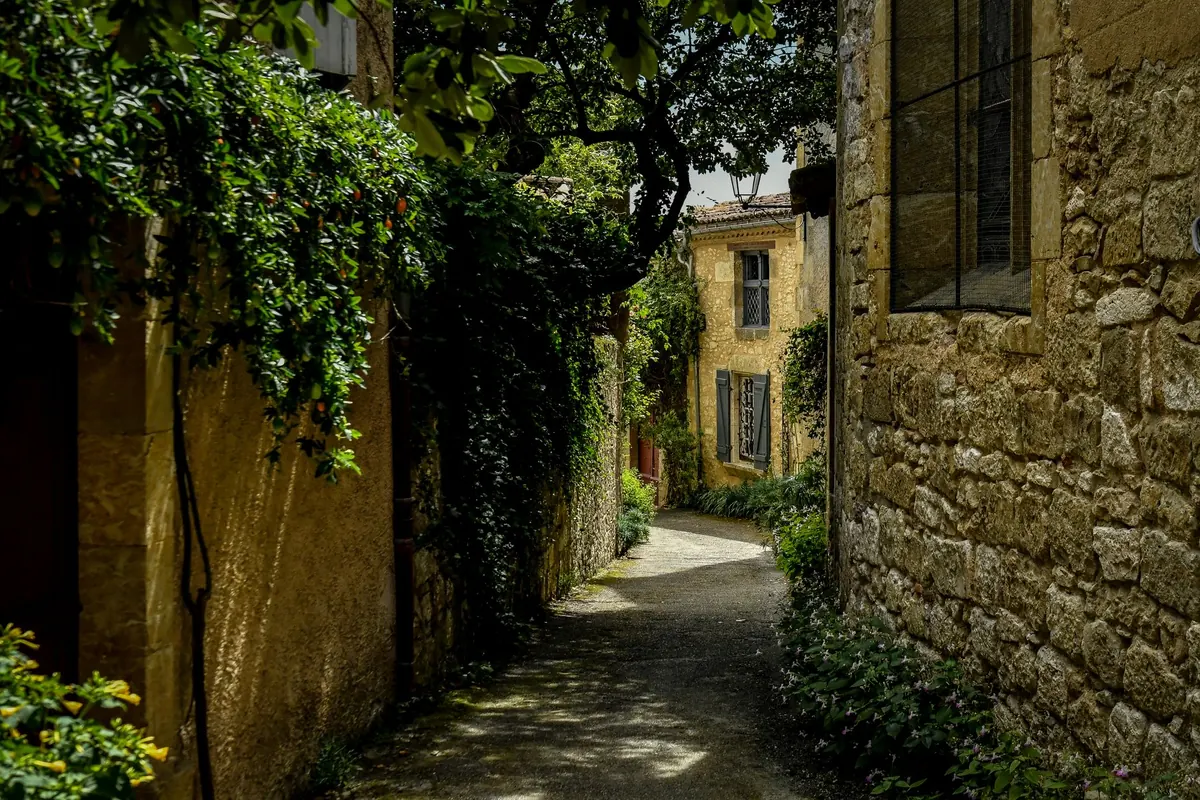
Occitania keeps its troubadours quietly. You can drive past a village square with a worn plaque, park beside a field, and walk ten minutes to a ruin where the most famous lyric poet of the twelfth century was born, sang, or was mocked. The songs themselves survive in manuscripts kept far from here; the places that produced them are still in the landscape, which is why this route works better as a slow drive than a checklist. Seven stops, roughly north to southeast, with time left over for lunch.
Start on the rock spur above Moustier-Ventadour in the Corrèze, where the ruins of the Château de Ventadour look down over a green valley. This is the household of Eble II of Ventadour, and the place where Bernart de Ventadorn learned his craft. His later Occitan biography claims he was the son of a servant — a baker, in some versions — inside the castle, which is either true or a very good story about how courtly love worked as social climbing.
The walk up is short but steep and the stones are uneven, so wear real shoes. What remains is a shell of walls, a cistern, a stretch of stair; there is no museum, no audio guide, and that is the point. Stand at the top and you can hear exactly what Bernart heard: wind, birds, and nothing else. Allow forty minutes on site. The village below has a Romanesque church and a café that may or may not be open — bring water.
Toulouse was the capital of the counts who lost the Albigensian Crusade and kept their court going anyway. Raimon VI and his son Raimon VII presided over a city of brick, trade, and legal argument, and troubadours passed through looking for exactly that combination. Walk the old town with two stops in mind: the Couvent des Jacobins, whose single-column vault spreads out like a palm tree above the nave, and the basilica of Saint-Sernin on the pilgrim road, where the scale tells you how rich this city already was.
The later chapter is here too. In 1323 a group of townsmen founded the Consistori del Gay Saber to codify the rules of Occitan verse and hold a poetry competition; it survives as the Académie des Jeux Floraux, which still awards a golden violet. That institutional continuity is rare in troubadour territory and worth a moment's thought over a glass of Fronton.
In August 1209 the Cité of Carcassonne fell to Simon de Montfort, and its young viscount Raimond-Roger Trencavel died in prison a few months later. The Chanson de la croisade albigeoise, written in Occitan verse by Guilhem de Tudela and an anonymous continuator, is the great documentary poem of that catastrophe — read a few lines before you walk the double walls, and the tourist spectacle gets considerably darker.
Then drive south into the Aude hills to Puivert, where the castle has a room known as the Salle des Musiciens, with carved figures playing instruments. Local tradition holds that troubadours gathered at Puivert's court; the castle was taken in 1210 during the same crusade. The lake below and the village museum make an easy half-day. Check opening hours before you go — hill castles in the Aude close out of season.
Ermengarde of Narbonne governed the viscounty in the second half of the twelfth century and appears in more than one troubadour biography as a patron and a subject of admiration. Bernart de Ventadorn and Peire Rogier are both placed at her court in those later accounts, and whether or not every detail is reliable, the pattern is: a woman with real political authority, poets writing for her approval, and a city rich enough to support them.
Narbonne rewards a wander. The Horreum is a Roman warehouse under a medieval street; the archbishops' palace straddles the canal; the cathedral of Saint-Just stops abruptly because construction was abandoned, leaving a choir with no nave. Stand on the Pont des Marchands and look at the water — this was a port city until the river moved, which explains a great deal about its medieval confidence.
Montpellier under Guilhem VIII was a city of merchants, doctors, and lawyers, and a documented stop for wandering singers. It also carries one of the region's most durable legends: that the ladies of Montpellier held a court of love, hearing cases about manners and fidelity and ruling on them like a tribunal. Later Occitan writing repeats the claim; no minutes survive. Treat it as a story about reputation, not a fact to repeat as history.
Walk the Écusson, the old town, and look for the medieval lanes around the Saint-Pierre cathedral, then escape the heat in the Jardin des Plantes, which has been planted since the sixteenth century. This is a good overnight stop for the sheer usefulness of the place: trains, hotels, and a tram that gets you out of the car for a while.
Raimbaut de Vaqueiras came from Vacqueyras, in the Vaucluse, and did what a talented younger son did — found a court. He served the princes of Orange, then followed Boniface of Montferrat to Italy and wrote some of his best work abroad. His most famous piece, Kalenda Maya, was written to a dance tune he heard from two French performers; the melody survives, and it is the closest thing we have to hearing a medieval dance floor.
Base yourself near Orange. The Roman theatre's stage wall is still standing, the tallest thing in town, and the hill of Saint-Eutrope above it carried the castle of the princes Raimbaut served. Vacqueyras itself is a wine village with a plain church and a good cellar or two — a reminder that troubadour patronage was never separate from land and income.
Finish in Aups, in the Var, where Blacatz — Blacas, lord of the town — was a patron and a friend to poets, Sordello among them. When Blacatz died in 1236, Sordello wrote a planh, a formal lament, that turned grief into satire: since the great kings of Europe had lost their courage, they should eat the dead man's heart and take some of his valour. It is one of the most quoted poems in Occitan, and it was written about a man from this small town at the foot of the Verdon.
There is no castle left to visit. What remains is the shape of the town, the market square, and the olive groves and truffle oaks around it. Go on a weekday, buy something from a stall, and read the lament's first lines before you leave. It is a fitting end to a route built on patrons rather than poets: the men with the money got the castles, and the poets got the last word.
Distances are manageable: Toulouse to Carcassonne is about an hour by train if you want to abandon the car for a day, and Narbonne to Montpellier is an easy motorway run. Ventadour sits well north of the main axis, so pair it with a night in the Corrèze rather than trying to bolt it onto a Provençal itinerary.
Read a little before you go — a handful of poems in translation will do — and the stops stop being pretty villages with plaques. They become rooms where somebody once tried to make a living out of a song.
Photo: ARNAUD VIGNE / Pexels
When the Albigensian Crusade broke the small courts of Languedoc, troubadours lost their audiences, their patrons...
A practical packing checklist for medieval music festivals, covering instruments, repair kits, layered clothing,...
The spring opening was the troubadours' signature move: birds, leaves and May weather set the stage before the poet...

Daily songs and stories from a troubadour.
